
The challenge: AI was producing reports, not useful intelligence
A major sovereign wealth fund wanted AI to continuously identify emerging technologies, companies and market developments relevant to its portfolio. It had already experimented with automating this research. The problem wasn’t generating content. It was generating intelligence that stakeholders could use.
A previous vendor engagement had left stakeholders dissatisfied with the relevance of the results. The balance was wrong: too much noise, too little signal.
Earlier research samples illustrated the difficulty. Reports presented broad industry trends, generic technology recommendations and impressive-looking analysis, without always providing verifiable evidence or a clear connection to portfolio-company decisions. Some looked decision-ready before the underlying evidence was.
The fund needed something different: a system that understood each company’s strategic priorities, identified meaningful developments, distinguished actual deployments from marketing announcements, and explained why the findings mattered.
The challenge wasn’t to automate research. It was to automate the judgment that makes research useful.
Our approach: start with the business, not the search engine
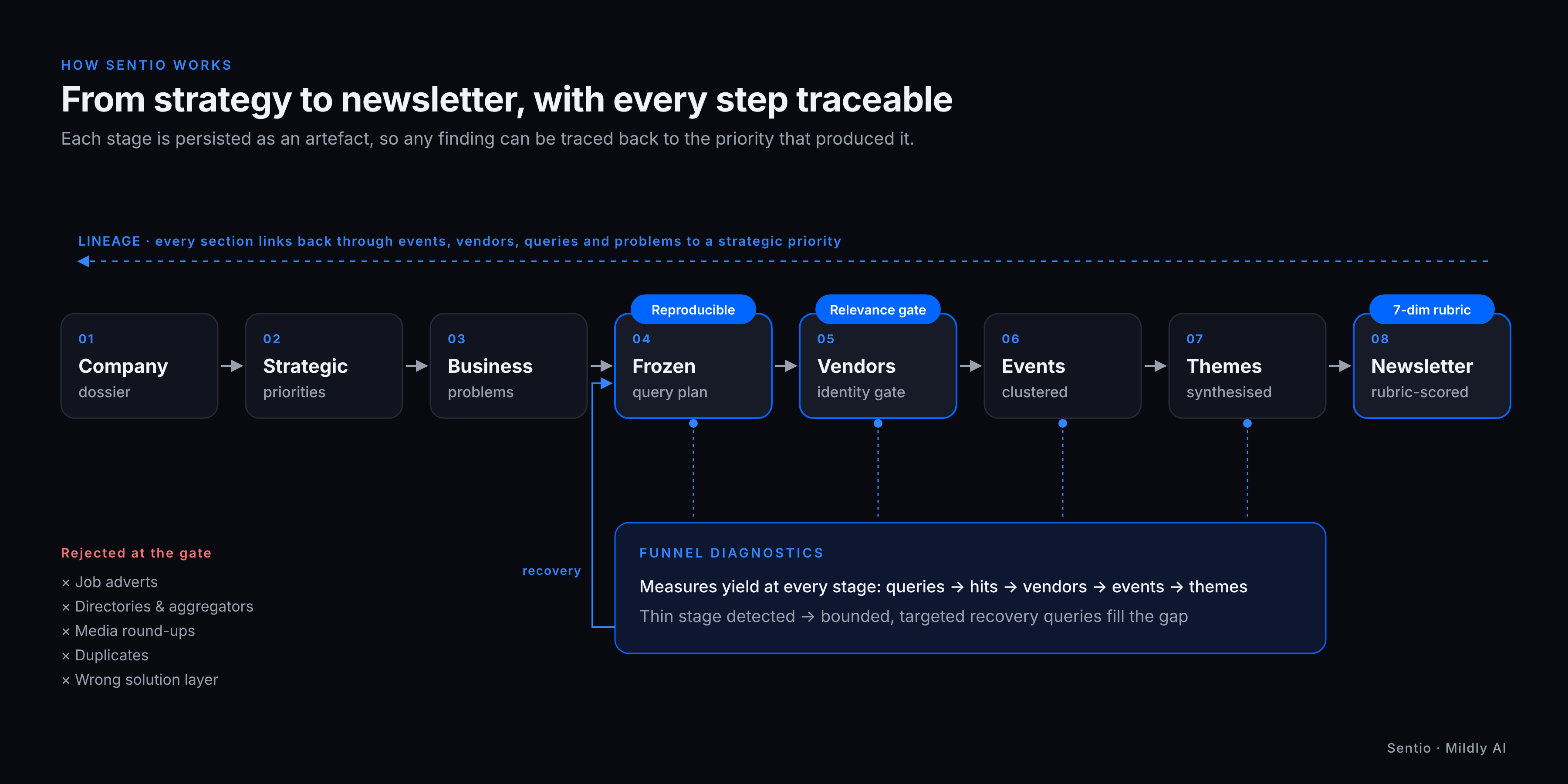
Sentio begins where a good analyst would: with the company. A strategy dossier captures each portfolio company’s priorities and operating constraints. Those priorities become concrete business problems, and the problems drive a structured query plan for vendors, deployments and market moves. Every stage is saved as an artefact, so each finding carries its lineage back to the priority that produced it.
Relevance is built in from the first step, rather than filtered in at the end.
Engineering intelligence, not summaries
Relevance gates that actually gate
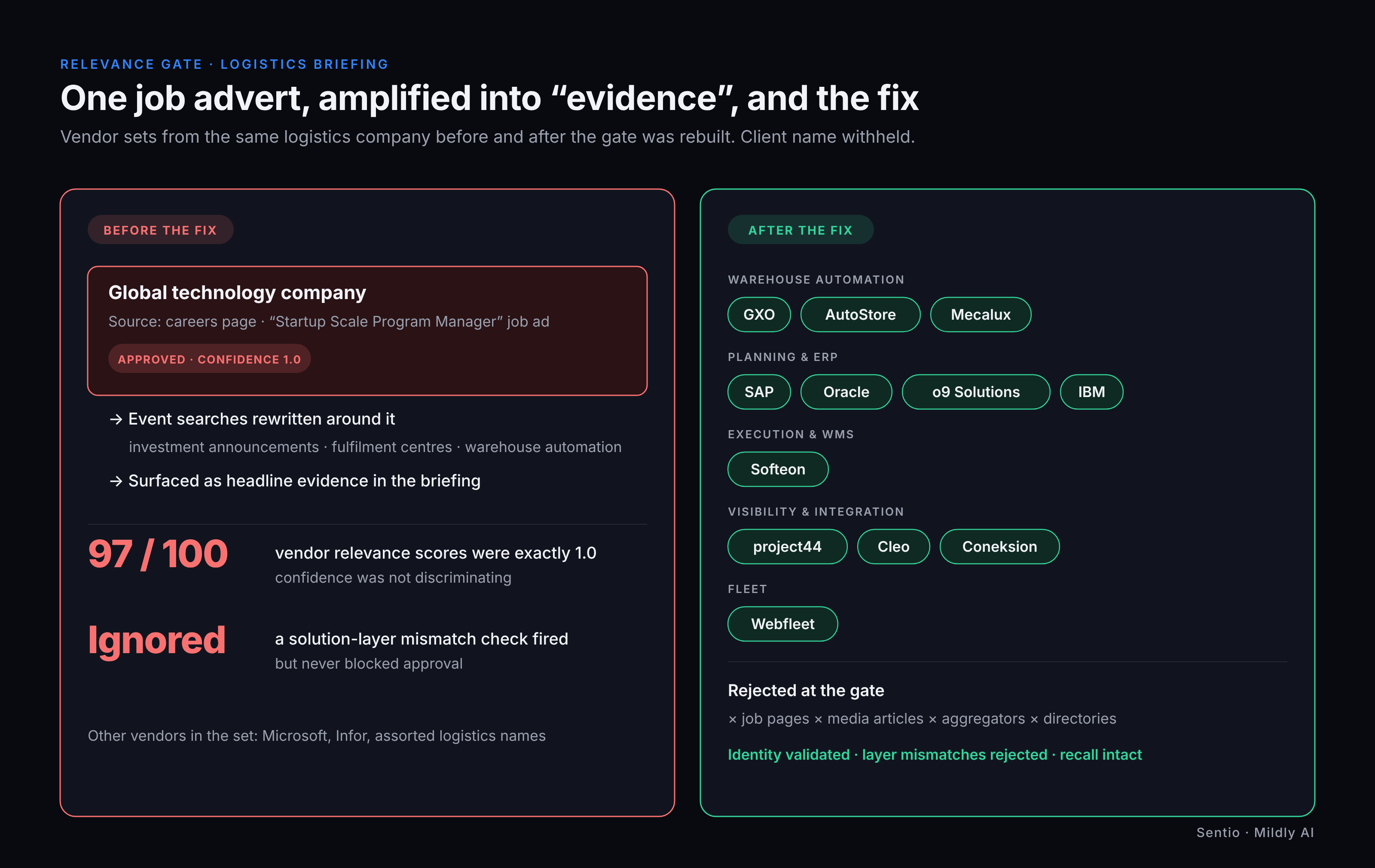
Early on, a job advert on a global technology company’s careers site, for a “Startup Scale Program Manager”, was mistaken for a vendor signal in a logistics company’s research. The relevance check approved it with a confidence of 1.0. Sentio then rewrote its event searches around that company, found genuine stories about its logistics investments and fulfilment centres, and promoted them to headline evidence.
Tracing the lineage exposed two deeper faults. Confidence had stopped discriminating: 97 of 100 vendor scores were exactly 1.0. And a check that compared the vendor’s actual solution layer with the one the query was looking for was detecting mismatches and then ignoring them.
We rebuilt the gate. Identity validation now confirms that a candidate is a genuine vendor operating in the right solution layer, mismatches are rejected outright, and job pages, media articles, aggregators, directories and duplicates are filtered out before they can seed anything downstream. The next logistics run returned a clean landscape of warehouse-automation, planning, visibility and fleet platforms, and healthcare runs kept their full vendor recall.
Asking the questions buyers actually answer
The first query generator pushed every problem through the same template of broad landscape, platform and API-ecosystem searches. That suited sweeping modernisation problems, but narrow operational ones, such as terminal capacity or corridor utilisation, came back full of generic platform vendors. Sentio now reads the shape of each problem and builds three to seven pathways to match. It keeps a guaranteed floor of one vendor-category search, one deployment-oriented search that looks for who has actually selected or rolled out a technology, and startup discovery where it is relevant. Evidence of adoption beats evidence of marketing.
Diagnosing thin research instead of drowning it
Some companies produced thinner intelligence than others, and adding more queries did not fix it: most extra queries returned nothing, while the few that hit dominated. So Sentio measures its own evidence funnel at every stage, from queries to hits, vendors, events and themes. It pinpoints where research has run thin and launches bounded, targeted recovery to fill the gap rather than padding the report.
Take a thin run for a global fresh-produce group. Its plan of 54 queries was topped up with a capped 18 targeted recovery queries, aimed precisely at the under-covered stages, and yielded 153 event candidates for synthesis. Because recovery is bounded, it adds depth without letting cost or noise run away.
Reproducibility by design
Two runs for the same commodities business once produced 205 and 94 lineage paths. In the thinner run, a single query dominated and dragged the newsletter towards one niche. The obvious fix, temperature zero, did not deliver: the production model rejected it, and even a pinned snapshot running at zero could not stop small differences in search yield cascading into different vendors, events and sections. Sentio therefore freezes the query plan for each run. The same brief researches the same ground, and any difference between runs can be traced to the evidence rather than to the model.
From facts to insight
A list of vendor announcements is not intelligence. Sentio clusters related events, synthesises them into themes that explain what is shifting and why it matters to an operator, and attaches the supporting sources to every section. Each edition is then scored against a seven-dimension editorial rubric of five points each: thesis clarity, operator consequence, evidence quality, section architecture, title and framing, insight density and editorial optionality. That makes “better” something the team can measure and act on, rather than argue about.
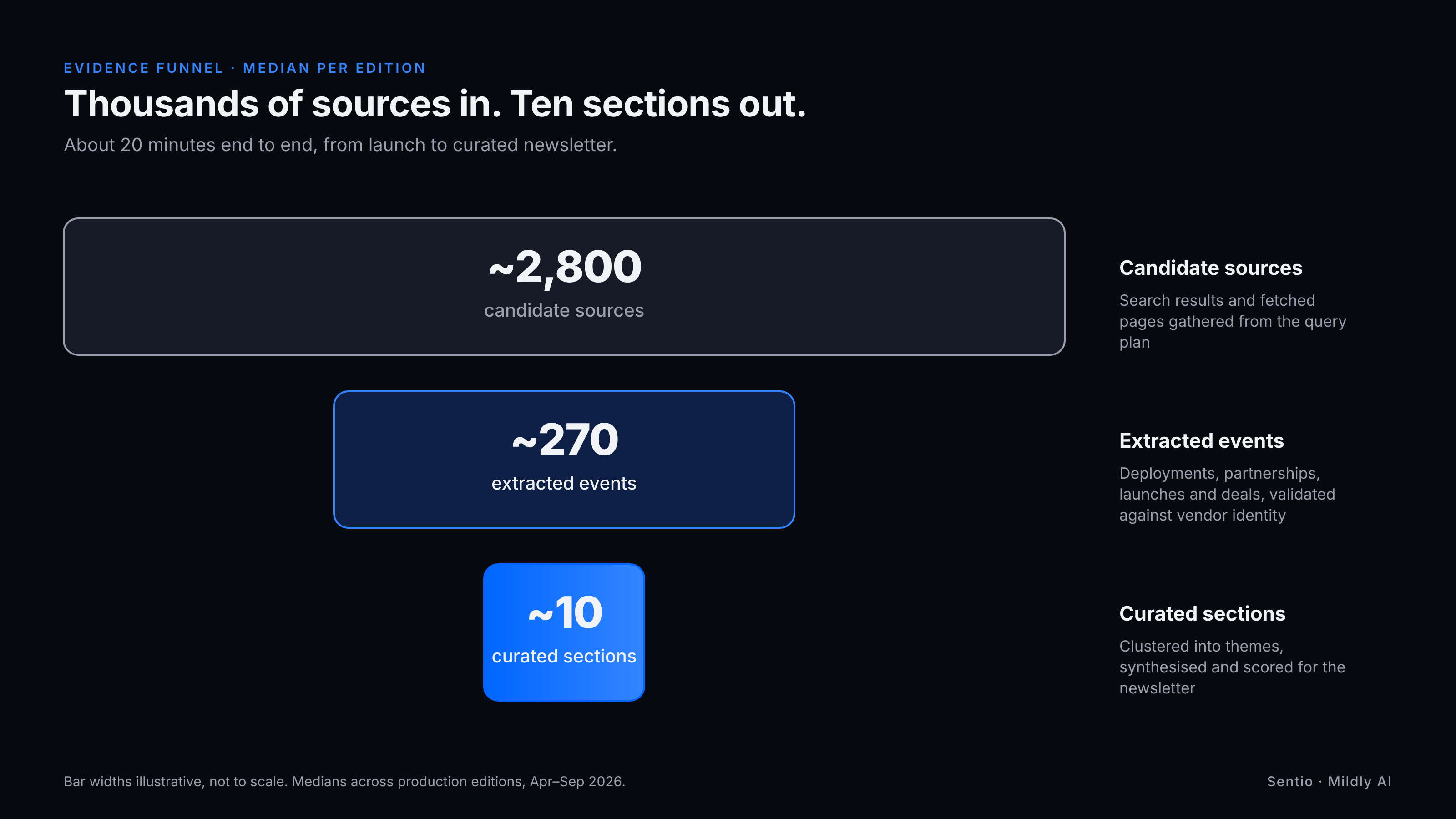
The combined effect is substantial. Each edition distils a median of around 2,800 candidate sources into roughly 270 extracted events and about 10 curated sections, in around 20 minutes end to end. Editorial quality rose from 5.3 to 9.7 out of 10.
Internal editorial assessment on a seven-dimension rubric; peak score shown.
From prototype to self-service product
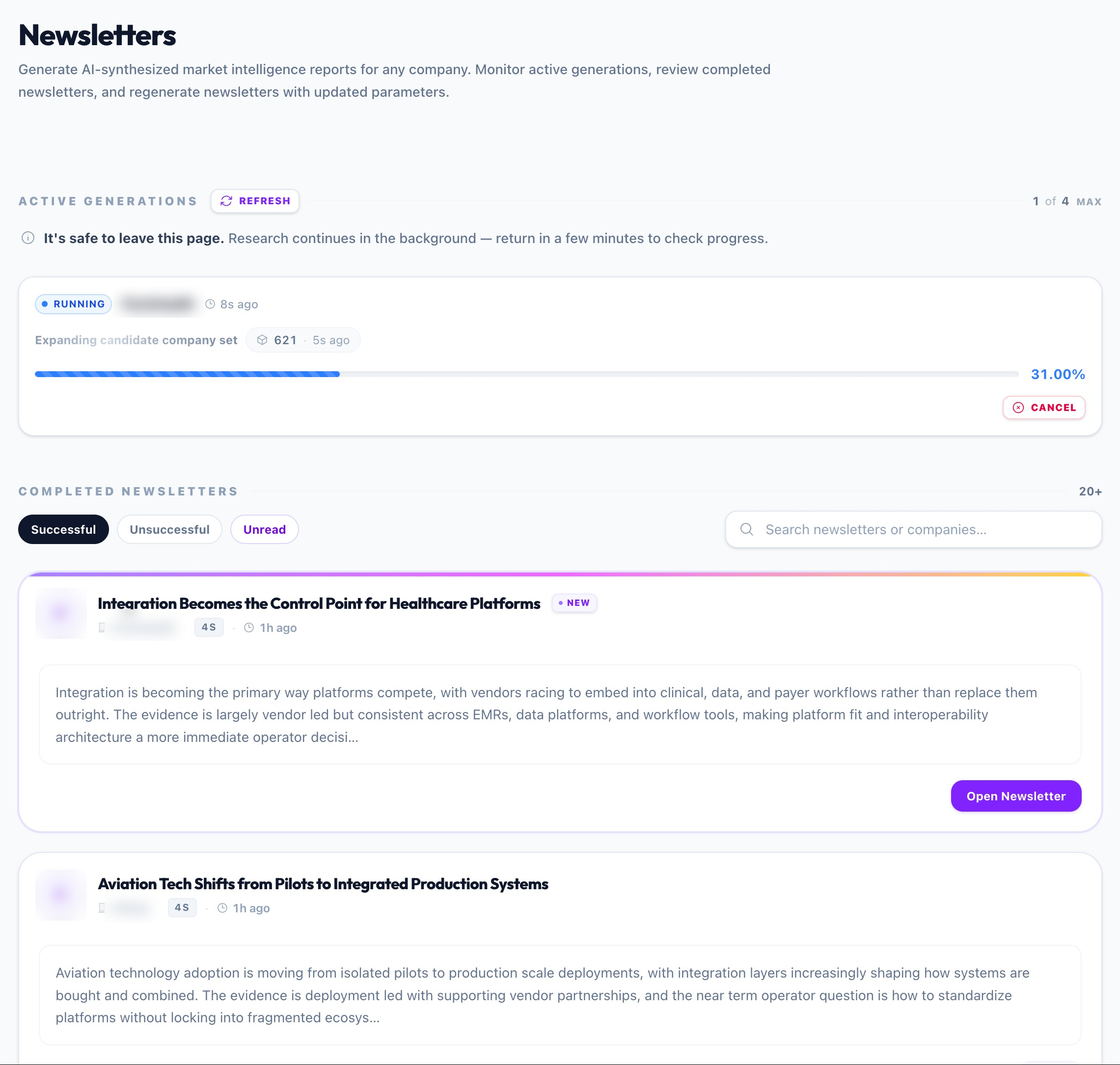
Sentio started life as a healthcare-only, command-line prototype operated by its engineers. Today it is a multi-industry application that analysts run themselves. They pick a company and launch an edition, then watch it move through named stages with a live progress bar. They can run up to four generations at once, leave the page while research continues in the background, and retry or cancel at will.
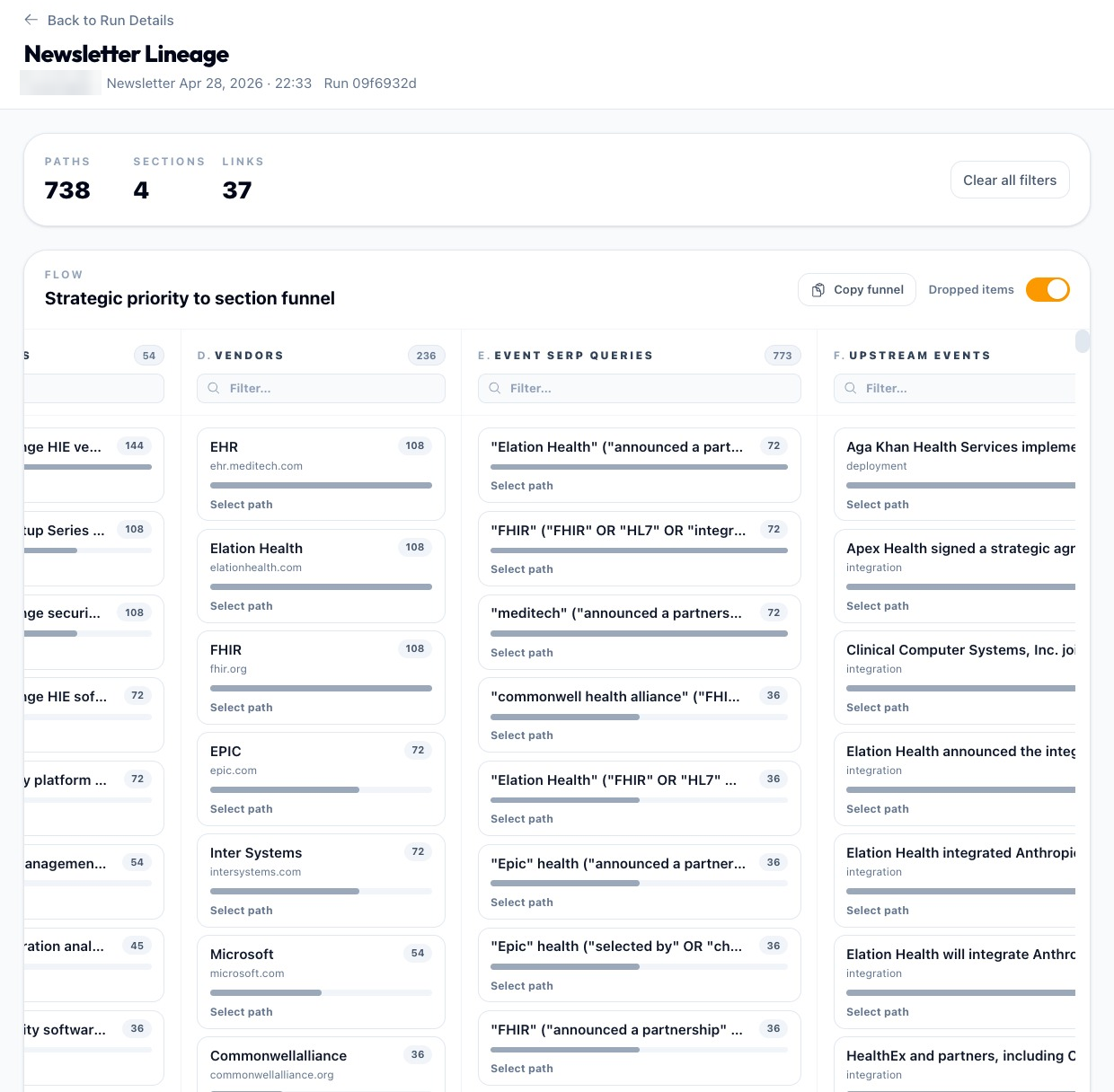
Completed editions are kept as persistent artefacts. A lineage view shows the full funnel behind every newsletter, from strategic priority through problems, queries, vendors and events to each section, including the items that were dropped and why.
And it runs at scale. Between April and June 2026, more than 1,000 pipeline runs produced 149 newsletters for 9 organisations across 7+ industries, from healthcare and logistics to agriculture and aviation.
What changed for the client
- From manual scouting to on-demand editions. Briefings that depended on manual specialist research now run in about 20 minutes per company.
- Intelligence tied to each company’s strategy. Every edition starts from that company’s priorities, not a generic industry feed.
- Evidence leaders can trust. Every claim links to its sources, and every section can be traced to the priority behind it.
- Consistency across clusters. The same pipeline, rubric and format serve healthcare, logistics, agriculture, aviation and more.
- Analysts in control. Teams launch, monitor and review research themselves, with no engineer in the loop.
The outcome
The clearest verdict came from the people reading it. Stakeholders said Sentio’s first newsletter could be circulated without a single edit, a decisive step beyond the organisation’s earlier approach.
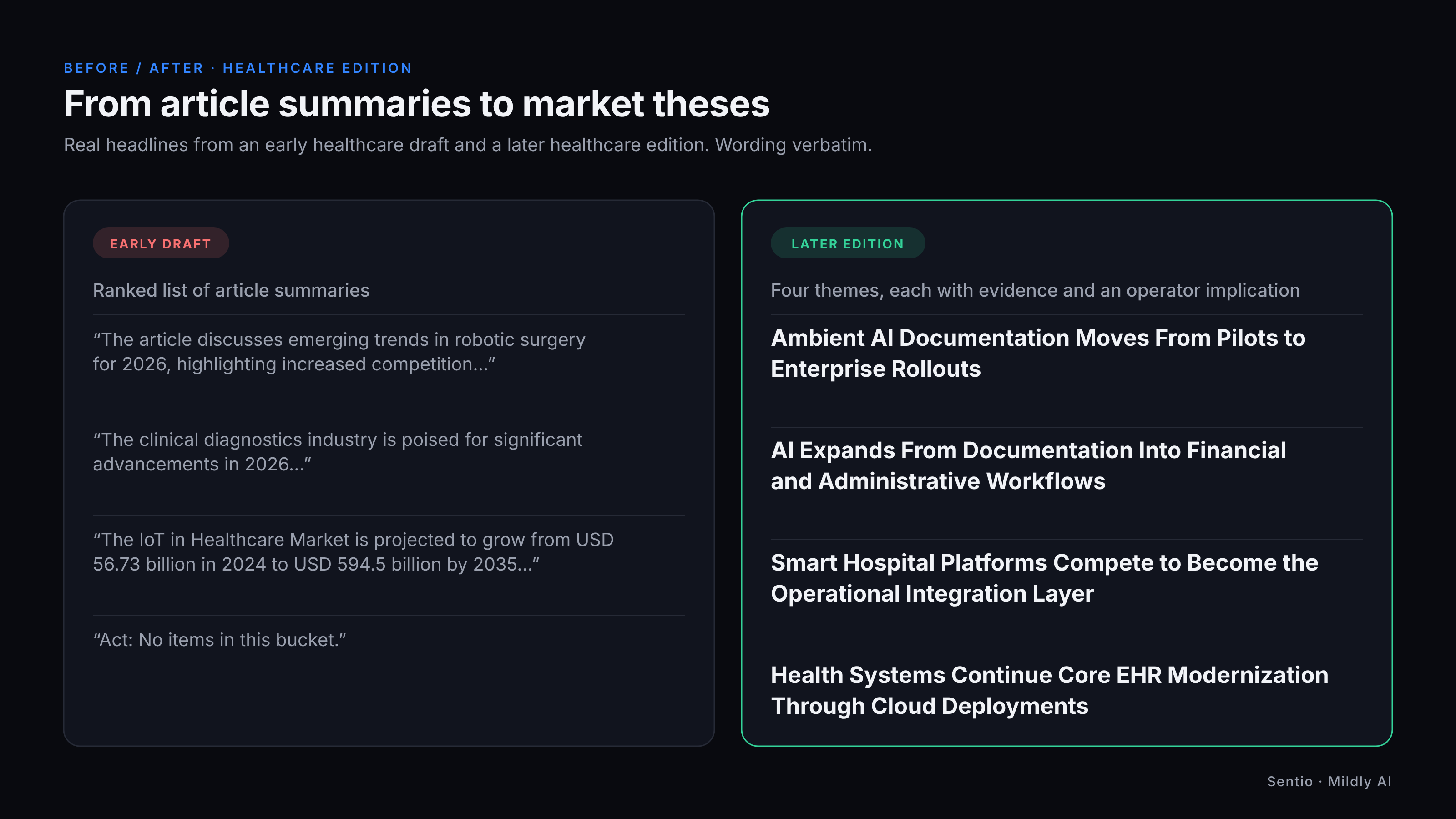
Later editions moved further still, from vendor round-ups to genuine market theses: not “these companies made announcements”, but “here is the shift under way in your industry, here is the evidence, and here is the decision it puts in front of you.”
The broader lesson
Better models alone would not have solved this. What made the difference was treating output quality as an engineering problem: start from the decisions people need to make, instrument every stage, find exactly where quality breaks, and fix the system rather than the prompt.
That is how Mildly AI turns ambitious AI initiatives into products people rely on.